

(Bottle) fed up
Or: Just let me feed my baby in peace

The decision to bottle feed my son was easy: I never had any interest in breastfeeding. As a gender diversity researcher, I felt very comfortable with my choice, as I had done my research, which is what I do for a living. Despite all of this, even though bottle-feeding has worked great for my family, I have felt the constant need to justify my decision, to the point where I began to wonder what my decision against breastfeeding said about the quality of my mothering.
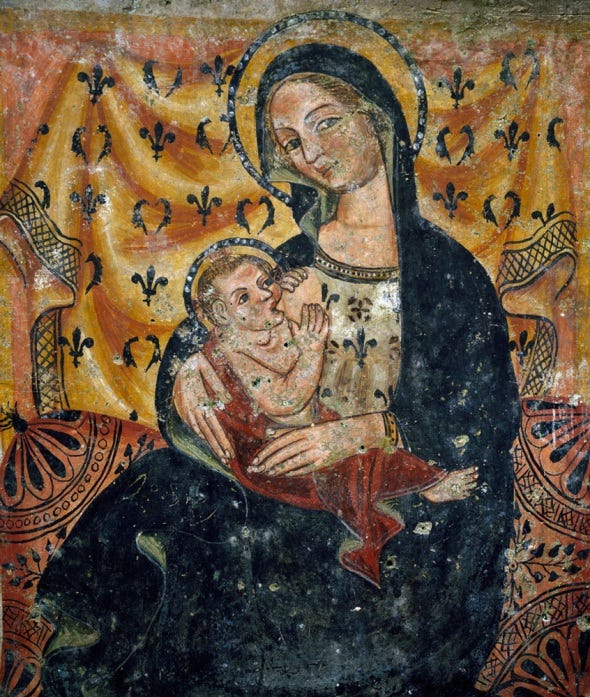
Many years before momfluencers breastfeeding on my social media feeds, I was exposed to breastfeeding as the “norm.” I grew up in Switzerland among crunchy-granola hippie student friends of my parents; everyone in our alternative, socialist circles of Zurich breastfed in public before I ever even realized this might be controversial. To cap it off, my mother was a theologian and pastor, surrounded by images of Mary feeding baby Jesus.
If I had to pinpoint the moment when I realized that breastfeeding wasn’t for me, it was in late January 2009. I was 20 and on the kind of birth control pill that used to be standard – very high dosage, very widely prescribed, wild side effects, few questions asked. I was madly in love with my first boyfriend. One night, I noticed two white-ish circles when I took off my black bra. There was a slight smell of sour milk. I don’t like this, I thought. For just a second, I felt a strange sense of disconnectedness bordering on disgust, as if my body had betrayed me, rushed ahead of me in a direction where I didn’t want to follow.
When friends and acquaintances who already had babies told me about how they were struggling to breastfeed, about how their nipples were chapped, about how upset they were that the milk wasn’t flowing, that the baby wasn’t latching, I professed empathy (“This sounds so hard!”) and wondered, privately and uncharitably: “Why are they doing that to themselves?”
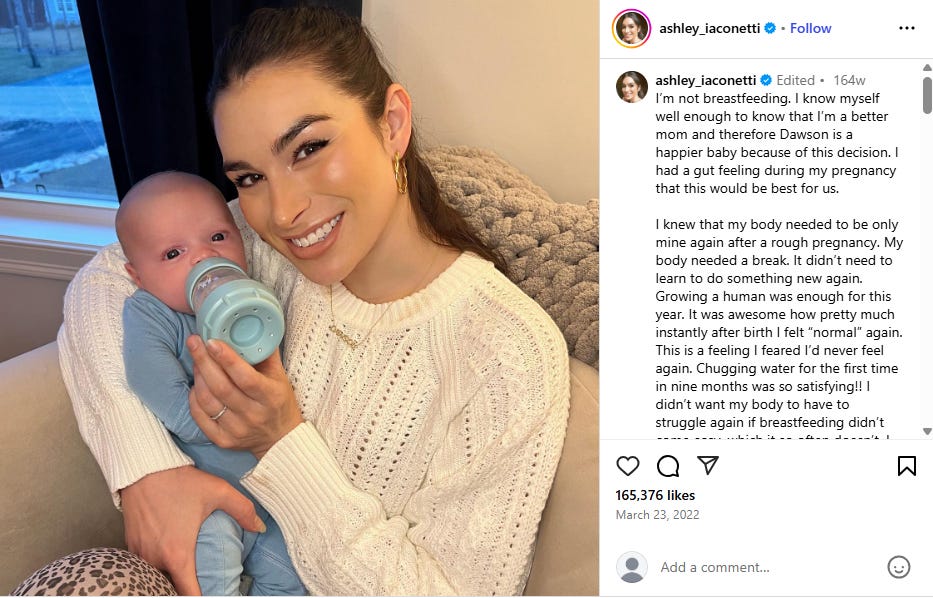
It was a relief when former (US) Bachelor contestant Ashley Iaconetti announced in an Instagram caption that she wasn’t breastfeeding her son, Dawson: “I'm not breastfeeding,” she wrote. “I know myself well enough to know that I'm a better mom and therefore Dawson is a happier baby because of this decision.” Seeing an influencer posting a bottle-feeding photo, rather than the obligatory breastfeeding photo, made me feel a sense of permission, just as I was trying to get pregnant for the first time.
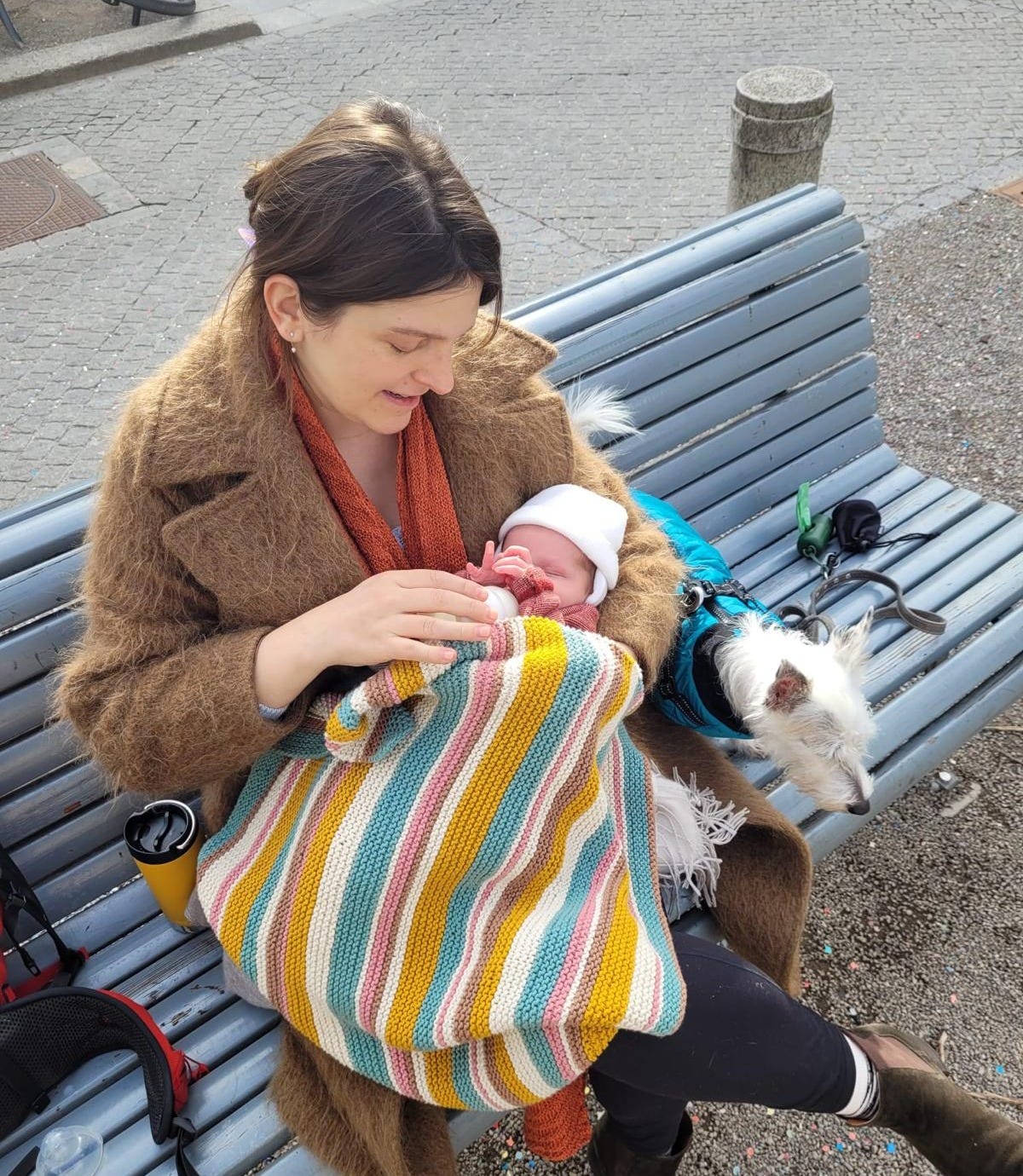
I felt (and feel) no urge to feel a baby’s mouth close around my nipples (according to novels I’ve read, some people do). Feeding my child with my own body has never been part of how I imagined my motherhood journey. Except, of course, I do feed my child with my own body: My hands hold his glass bottle, my son is nestled in the crook of my elbow, cradled against my stomach, and my arm is slowly falling asleep under warm, sticky baby weight. But the milk I create by mixing powder with warm water and shaking a glass bottle is not what people call “mother’s milk.”
When I got pregnant, most people just assumed that I would breastfeed, which is very much the norm for mothers where I live, especially for my demographic profile. 95% of mothers in Switzerland breastfed their babies after birth, and 50% of Swiss babies are exclusively breastfed for at least 12 weeks; breastfeeding rates are higher for mothers like me, over 30, well-educated, and socioeconomically comfortable.1 The socio-economic aspect of breastfeeding is really important: If you do shift work, manual labor, if you work multiple jobs, and/or if you don’t get parental leave, how would you maintain breastfeeding or even pumping? Where would you find the time, the space, the resources? Where would you store and clean your pump? Where would you cool your pumped breastmilk? (But that is a topic for a future essay. This essay is unabashedly about me.)
My swollen belly and waddling gait felt like a signal to mothers around me to welcome me into a sisterhood of nighttime feedings, a secret society of nursing pillows and breast pumps, complete with hazing rituals of mastitis and extreme hormone swings. When I told people, “I’m planning to bottle feed,” this was never the end of the conversation, even though I put a lot of effort into never injecting the sentence with even the tiniest inflection, even one hint of question or uncertainty.
“Don’t forget that you’re legally entitled to an hour a day of paid time off to breastfeed or pump,” a work acquaintance told me at the end of a meeting when I was 7 months pregnant. (I love this law! Breastfeeding and pumping are hard work, and I think it’s amazing that there is paid time off to make this easier. Don’t get me wrong.) “Why???,” the colleague asked after I said thanks but no thanks, I was planning to bottlefeed, then gently tried to change the conversation.
The conversation almost never ended there. “I just don’t want to breastfeed,” I would say, as I do believe that it is my body, my choice, that “I don’t want to” is a complete sentence that requires no follow-up. But there was always (well-meaning, incredulous) follow-up.
“Are you sure? Can I give you a book about the benefits of breastfeeding? The science is really clear, you know,” a friend who is a gender studies professor told me. Except … the science isn’t all that clear. Yes: the best available data shows 4 percent fewer gut infections and 3 percent less eczema in the first year for breast-fed babies. High-quality data does not support claims of higher intelligence, longer-term health benefits, and improved parent-child relationships. While breastfeeding is great for mother-child bonding, bottle-feeding can positively affect fathers’ parenting self-efficacy, their relationship with their partner, and father-infant bonding.
Here’s a question that might seem outrageous coming from a researcher: Does the research even matter? Even if there was clear-cut evidence that breastfeeding had a direct, positive effect on my ability to bond with my child, my child’s gut health, their likelihood of developing allergies, and risk of obesity, … would that be reason enough to expect me to use my body to do something that I don’t want to do? Isn’t it still, first and foremost, my body, my choice?
The most extreme but widespread stance is that it is, at this point, not about my body. In her essay, The Milky Way of Things, nurse and post-partum carer Emily Hancock writes: "Yes, it is produced in the breast, and we call it endearingly “Mother’s Milk” (and it is of course), but in perceiving of it the most truthfully, it is the baby who this milk is made for and it is the baby who is naturally owed this most precious possession."
Perhaps more subtle, the institutionalized message to expecting and new mothers is: Breast is best. Take the Baby Friendly Hospital Initiative (BFHI), launched by the World Health Organization and UNICEF in 1991 as a global effort to implement practices that protect, promote, and support breastfeeding.2 Hospitals seeking that Baby Friendly designation must adhere to specific guidelines promoting breastfeeding, such as treating breastfeeding as the norm and providing breastfeeding assistance. Staff must follow step six in the “Guidelines and Evaluation Criteria for Facilities Seeking Baby-Friendly Designation,” which reads: “Give infants no food or drink other than breast milk, unless medically indicated.” If you want formula, you (post-partum, hormonal, emotional, exhausted, overwhelmed) have to ask for it.3
The strategy is to empower women to choose to breastfeed: “Every mother should be informed about the importance of breastfeeding and respected to make her own decision” – but informing her that “there is no question that breastfeeding is the optimal feeding and caring method for the health of both the baby and the mother.” You can choose not to breastfeed, but it wouldn’t be the right decision. You can choose not to breastfeed, but you should question your choice, one of the first choices you get to make as a new parent.
Informed choice requires evidence for and against all options available. Dr Devika Bhushan, pediatrician and former Acting Surgeon General of California, writes in her brilliant essay, “What breast is best gets wrong”: “Existing guidelines also fail to sufficiently consider the potential costs of breastfeeding, including the sheer time and sleep loss it requires of the breastfeeding parent—which, in turn, can lead to inequities in parenting labor and the ability to work outside the home. If it goes well, breastfeeding can boost maternal mental health, but research also shows that wanting to breastfeed and having challenges can worsen mental health. When you’re unable to give your baby something you’ve been told is essential, guilt and shame can take hold.”
Somehow, the choice to bottle-feed my son, one part of my motherhood journey that I was most certain about, has become riddled with doubt, which once more rears its ugly head as I’m pregnant with my second child. Were people seeing me as a mother who wasn’t prioritizing her baby’s needs over her own (i.e., was I a bad mother?)? I still feel the constant need to justify myself over bottle-feeding. I’ve become a walking, talking advertisement for my BabyBrezza, a baby formula Nespresso machine that is my number one MVP baby purchase. My stance started soft: Everyone should choose the feeding method that fits their circumstances best. Let’s not judge moms. What’s right for me is not right for everybody else.
And yet, the more I repeat what have become my talking points (“It’s been so beneficial for my mental health to get sleep right after birth!”; “The father-baby bonding experience has been lovely!”; “After a horrible pregnancy, I loved getting my body back just to myself,” etc.), the more I feel myself hardening in my stance. My chosen feeding path has so many advantages; why can’t everybody else see that? There are so many breastfeeding advocates; shouldn’t someone make the case for the other side? I don’t like this version of myself, this broken record, this proselytizer existing in black and white rather than shades of gray. And the funniest thing? If I had chosen to breastfeed, my experience of doubt, of justification, of hardening and judgment, would have been remarkably similar, because we simply can’t let parents make their personal choices in peace.
The Federal Food Safety and Veterinary Office in Switzerland finances the collection and analysis of data on infant nutrition in Switzerland every ten years. Data cited in this article is from 2014; new data is expected this fall. Similar socio-economic patterns for breastfeeding behavior were found in studies covering other countries.
The BFHI was started in response to the deeply unethical marketing practices of baby formula producers that led to the death of hundreds of thousands of infants in low-income countries. You can read the original investigative report that sparked a decades-long boycott here, and a shorter article here.
This deep dive of the Baby Friendly Hospital Initiative explains well how well-meaning healthcare initiatives can create undesirable outcomes.
Nora, thank you for this! I wanted so badly to breastfeed Ben & felt so guilty when I ‘failed’ (same with the C-section when he was born). The truth is, bottle feeding lessened my post-partum depression, let me sleep well again, and brought his dad into his care more fully, more quickly. What a relief (even at this age and stage when Ben has his own kids) to hear someone I respect so much say this out loud!
Excellent conclusion. I breastfeed and feel the frustration from the other side - why do people insist on asking when I'm going to stop, why did they try to push formula in the earlier months when myself and my baby were doing just fine with breast milk, why can't they just sod off and stop questioning how my baby is being fed, that sort of thing. You're damned if you do and youre damned if you don't, so just keep doing what's right for you